

Why Consistent Needle Quality Matters in 2026
Table of Contents
- Why Consistent Needle Quality Matters in 2026
- Precision Engineering and Dimensional Tolerance in Needle Manufacturing
- Minimizing Skin Trauma with High-Quality Needles
- Tattoo Needle Cartridge Stability: Why It Decides Procedural Reliability
- How to Identify High-Quality Tattoo Cartridges
- Sterilization Validation and Material Degradation: What Artists Should Know
- Conclusion: Consistency Is the Foundation of Professional Tattooing
- Frequently Asked Questions
Last Updated: October 4, 2026
Why Consistent Needle Quality Matters in 2026
Consistent needle quality is the single most controllable variable in a tattoo procedure, and in 2026 it separates studios with repeat clients from those dealing with reworks. At Emalla Canada, we supply professional artists across the country, and the pattern we see is blunt: inconsistent cartridges cost more in touch-ups than any box of needles ever saves.
Here is the practical reality. A cartridge that varies from box to box forces the artist to adjust hand speed, voltage, and ink flow mid-session. That adaptation is invisible on the invoice but obvious in the healed result.
Needle quality is the measurable consistency of a cartridge's geometry, sharpness, membrane tension, and sterility across every unit in a batch. It is not a marketing tier. It is a set of tolerances you can inspect, and it determines whether your lining is repeatable.
Precision Engineering and Dimensional Tolerance in Needle Manufacturing
Dimensional tolerance is the permitted variation in a needle's diameter, length, taper, and grouping, and it is where quality is won or lost. Two cartridges can both be labelled #10 round liner and still behave like different tools, because the label describes a nominal size while the tolerance describes the real one.

The Manufacturing Variables That Set Tolerance
Four production choices determine how tight a cartridge's tolerances can actually be:
- Point formation. Precision grinding removes material gradually and holds a repeatable point angle. Stamping shears the wire into shape, which is faster and cheaper but leaves micro-burrs and a less uniform tip.
- Taper geometry. A long taper spreads the point over more length, which suits lining and detailed work; a short taper concentrates it for packing color. If the taper length drifts between batches, the same cartridge feels sharper or blunter than the last box.
- Grouping alignment. In a round liner, the outer needles form a circle around the center. If that circle is not concentric, the effective line width changes even though every individual needle is the correct gauge.
- Diameter control. Wire is drawn to a target diameter, and the draw process determines how close to that target each needle lands. A stated 0.30mm or 0.35mm diameter is a claim you can verify with calipers; an unstated diameter is not a claim at all.
How Micron-Level Tolerance Affects Needle Gauge Accuracy
A needle gauge is a nominal size, not a guarantee. If a manufacturer's tolerance drifts, a #10 round liner may sit closer to a #12 in practice, and your line weight changes without any adjustment on your part. This is the mechanism behind the "this box feels different" complaint artists report.
The fix is specification, not guesswork. Look for cartridges that state their diameter explicitly, such as the 0.30mm #10 or the 0.35mm #12 in the EMALLA ELIOT ROUND LINER LONG TAPER range, because a stated diameter is a claim you can verify against the physical product.
Comparing Consistent vs. Inconsistent Geometry
The difference is easiest to see side by side. Under magnification, a consistent batch shows every tip at the same angle, the same protrusion from the tube, and the same concentric grouping.
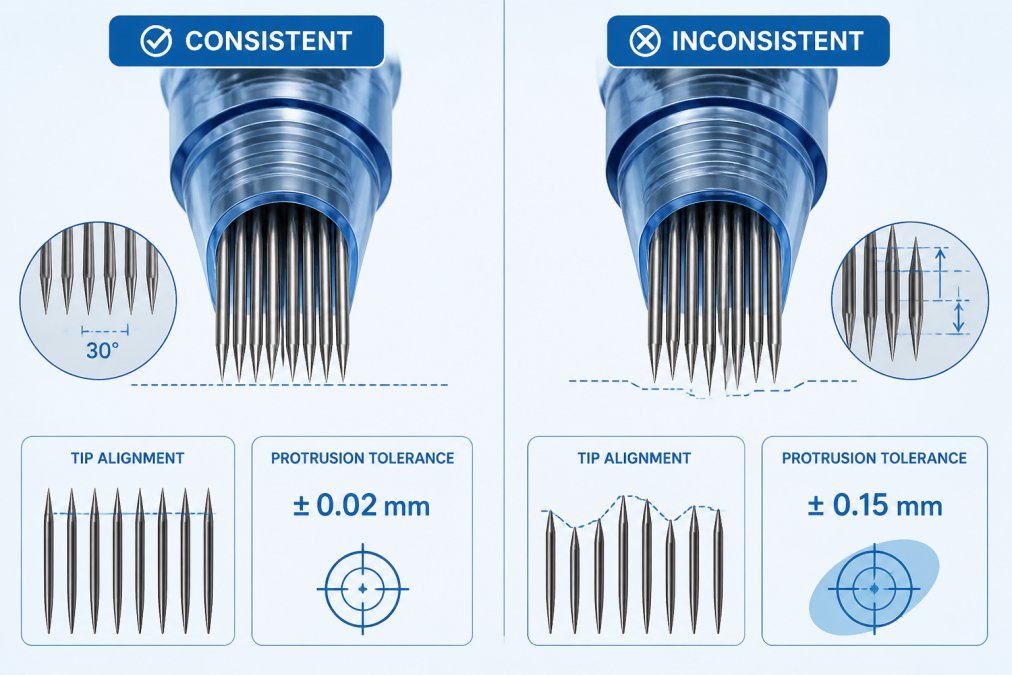
That visual difference is not cosmetic. Uneven tip protrusion means only the longest needle contacts the skin first, so the effective line is drawn by fewer points than the grouping implies.
Minimizing Skin Trauma with High-Quality Needles
Minimizing skin trauma with high-quality needles comes down to sharpness and surface finish, because a sharper, smoother point enters with less force. Lower insertion force means less lateral tearing, which translates directly into cleaner healing and less scar tissue.
Sharpness is not a one-time property. A needle point that is ground and polished correctly holds its edge through a longer session, while a poorly finished point dulls early and starts dragging.
Surface finish matters for the same reason. Imported Japanese stainless steel, used in the EMALLA ELIOT line, is chosen for exactly this reason: it holds a consistent point and resists corrosion.
- Sharper points reduce insertion force and lateral tissue damage
- Polished surfaces lower friction and pigment drag
- Consistent tensile strength prevents tip deformation mid-session
- Lower trauma means faster healing and fewer touch-ups
Tattoo Needle Cartridge Stability: Why It Decides Procedural Reliability
Tattoo needle cartridge stability determines whether the needle tracks straight or wobbles, and wobble is the enemy of clean lining. A stable cartridge holds the needle bar square to the tube, so the point lands exactly where you aim it, every stroke.
Instability usually traces back to the membrane and the bar design. A soft, thickened membrane with reinforced bars keeps tension even as the needle reciprocates, while a thin or uneven membrane lets the bar drift. The EMALLA ELIOT cartridges use a three-layer membrane with four thickened bars specifically to hold that tension.
Stability Is a Session-Length Problem
What most guides miss is that stability is a session-length problem, not a first-stroke problem. A cartridge can feel fine for ten minutes and start drifting at forty. If your long sessions always need correction near the end, cartridge stability is the first thing to audit.
The mechanism is mechanical fatigue. As the membrane flexes through thousands of reciprocations, a thin or uneven layer loses its rebound and the bar develops lateral play. Once that play appears, the artist unconsciously tightens their grip and slows their hand to compensate, which is where the human factors cost shows up.
The Human Factors Cost of Unstable Cartridges
This is the angle the market reports skip entirely: needle consistency is not just a clinical variable, it is an ergonomic one. An artist fighting a drifting cartridge holds more tension in the hand, wrist, and forearm for the length of the session.
EMALLA ELIOT TATTOO CARTRIDGE NEEDLES- ROUND LINER LONG TAPER #4 (0.18mm) →
A consistent cartridge removes that compensation. When the needle tracks where it is aimed, the artist can maintain a relaxed grip and steady hand speed, which improves both the healed result and how many sessions remain sustainable in a week. For studios booking back-to-back clients, that is a productivity variable, not a comfort detail.
Diagnosing Instability Before It Reaches a Client
Stability is testable. Run a straight line on practice skin at your normal voltage and hand speed, then repeat it after several minutes of continuous running. If the second line is wider, lighter, or less crisp than the first, the cartridge is drifting under load. Compare that against a cartridge from a batch you trust, run under the same conditions.
Stability Factor |
Weak Cartridge |
Quality Cartridge |
Impact on Procedure |
|---|---|---|---|
Membrane design |
Single thin layer |
Three-layer, thickened |
Even tension through long sessions |
Bar fixation |
Loose fit |
Square-fixed bar |
Straight tracking, less wobble |
Shell material |
PVC |
Medical-grade PC |
Safer, more rigid housing |
Ink control |
Backflow risk |
Sealed membrane |
Consistent flow, no jetting |
Session endurance |
Drifts after ~20 min |
Holds tension through long sessions |
Less grip fatigue, steadier lines |
How to Identify High-Quality Tattoo Cartridges
Identifying high-quality tattoo cartridges means inspecting four things: stated needle diameter, membrane construction, shell material, and sterilization indicators. If a supplier cannot tell you the diameter in millimeters and the sterilization method, that is your answer.
Start with the physical inspection. Open one cartridge from the batch and check the membrane for even tension, confirm the bar sits square, and look for the sterilization indicator on the packaging. Then run a single line on practice skin before committing to a client.
Certifications and Sterilization Indicators to Check
Sterilization indicators confirm that a batch was actually processed, not just labelled. For tattoo equipment sold in Canada, cartridges should carry an E.O. gas sterilization claim, and the packaging should show a chemical indicator that changed color during processing.
Look for the indicator strip, the sterilization method, and a batch or lot number. The lot number is what lets a supplier trace a defect back to a production run, and it is the first thing a serious distributor will ask for if you report a problem. If a box has no lot number, you have no recourse.
Sterilization Validation and Material Degradation: What Artists Should Know
Sterilization validation is the documented proof that a sterilization cycle actually kills microorganisms on the product, and material degradation is what happens when a cartridge is exposed to sterilants it was not designed for.
The practical risk is re-sterilization. Autoclaving a cartridge that was designed for E.O. gas sterilization can degrade the plastic shell and the membrane, warping the housing and weakening the tension that keeps the needle stable.
This is also where biocompatibility and regulatory compliance matter. Medical-grade PC shells are chosen because they tolerate the intended sterilization method without leaching or cracking.
For an independent reference point on how medical devices are classified and regulated for safety in this market, see Health Canada's guidance on medical device regulation. For sterilization practice standards, the ISO 11135 standard for ethylene oxide sterilization defines the validation requirements manufacturers work to.
Conclusion: Consistency Is the Foundation of Professional Tattooing
The hardest part of needle quality is that inconsistency hides until it costs you.
At Emalla Canada, we stock the EMALLA ELIOT cartridge range because it states its specifications: 0.18mm through 0.35mm diameters, imported Japanese stainless steel points, medical-grade PC shells, a three-layer membrane, and E.O. gas sterilization with 20 cartridges per box at $35.25.
If consistency is the foundation of your work, build on it. Browse the EMALLA ELIOT ROUND LINER cartridges and stock a supplier who can answer the technical questions. Get started with Emalla Canada and give your clients the healed result your technique deserves.
Frequently Asked Questions
How does needle consistency affect skin trauma during tattooing?
Consistent needle quality ensures every point contacts the skin at the same depth and angle. When dimensional tolerance drifts, some needles sit slightly longer or shorter, forcing the artist to adjust pressure mid-stroke. That uneven pressure increases tissue trauma, which can lead to heavier scabbing and slower healing. Cartridges built to tight tolerances, like the Emalla Eliot round liners with 0.18mm needles, keep insertion force predictable so the skin receives uniform punctures rather than erratic ones.
What should artists look for when evaluating tattoo needle cartridge quality?
Check four things: needle sharpness and alignment under magnification, membrane design that prevents ink backflow, shell material (medical-grade PC is safer than PVC), and sterilization indicators. Emalla Eliot cartridges use a three-layer membrane and a soft thickened membrane with four bars for durability. Also verify the gauge is printed clearly and matches the box. If points look uneven or the membrane feels loose, the cartridge will not deliver the stability you need for consistent line work.
Why do professional tattoo artists prioritize cartridge needle stability?
Cartridge stability keeps the needle bar from wobbling inside the housing. When that bar moves, the needle group spreads or shifts, causing inconsistent line weight and ink splatter. Stable cartridges also reduce hand fatigue because the artist does not have to compensate for vibration. Emalla Eliot cartridges use a square-designed plastic bar that fixes the needles firmly in place, which is why they perform well for lining and fine line work where every millimeter counts.
How can poor needle quality impact the healing process of a tattoo?
Blunt or misaligned needles tear tissue instead of cutting cleanly. That extra damage triggers a stronger inflammatory response, which can cause excessive scabbing, pigment loss, and longer downtime. Inconsistent needle geometry also means uneven ink deposition, so some areas may heal patchy. Using cartridges with sharp, precision-ground points and consistent gauge, such as the Emalla Eliot line, minimizes skin trauma and supports a smoother healing timeline for your clients.